

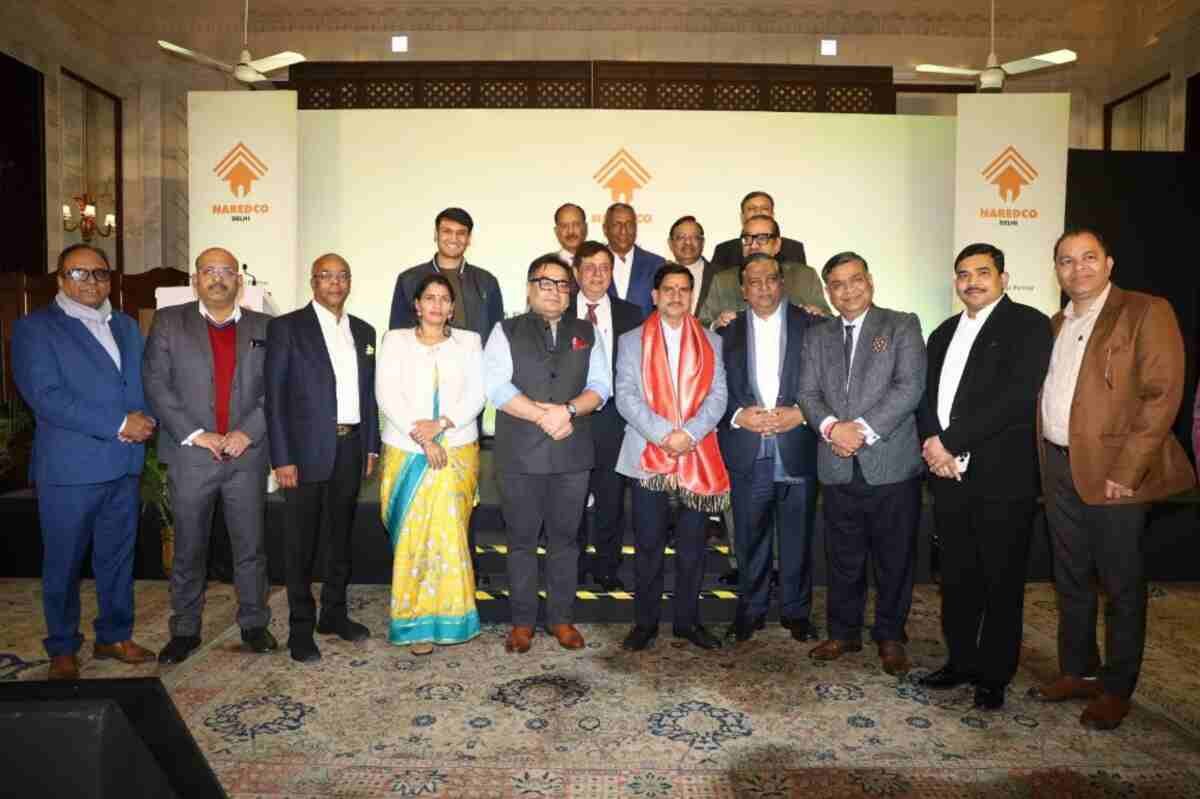
New Delhi, December 22, 2025: Against the backdrop of deteriorating air quality in the national capital, Union Minister of State for Housing and Urban Affairs Tokhan Sahu on Monday underscored the importance of public transport as the primary mode of urban mobility, urging cities to reduce dependence on private vehicles.
Speaking at Delhi Developers Meet 3.0, organised by the Delhi Chapter of the National Real Estate Development Council (NAREDCO) with JLL as Knowledge Partner, the minister stressed the need for multi-modal transportation systems and integrated urban planning.
“We need cities where people can comfortably rely on public mobility instead of private vehicles. Bringing homes closer to workplaces and strengthening last-mile connectivity are critical,” Sahu said, highlighting the urgent need to upgrade public transport infrastructure.
Emphasising sustainability, the minister noted that development should not be measured solely by economic growth. “Environmental protection must be an integral part of development planning,” he added.
Addressing the seminar on ‘Sustainable Redevelopment in Delhi and Transit-Oriented Development (TOD)’, Dr. Debolina Kundu, Director, National Institute of Urban Affairs (NIUA), said first-mile and last-mile connectivity would play a transformative role in urban redevelopment and significantly improve ease of living in cities like Delhi.
She pointed out that with its current growth trajectory, Delhi is expected to become the world’s largest urban centre by 2035, surpassing Tokyo. “Sustainable redevelopment and TOD can help cities emerge as growth hubs, improve ease of doing business and living, promote creative redevelopment, and support affordable housing,” she said, calling for an integrated approach to urban planning.
Explaining the TOD framework, Dr. Kundu said it integrates land-use and transport planning to create high-density, mixed-use, walkable, and liveable urban centres. “Such development ensures access to green and public spaces while optimally utilising transit infrastructure,” she added.
Highlighting Delhi’s rapid expansion, she noted that the capital has recorded the fastest growth in built-up area among Indian metros. “Between 2000 and 2025, Delhi’s built-up area grew by 48.1%, compared to 40% in Chennai, 30% in Kolkata, and around 16% in Mumbai,” she said.
Reshma Dudani, Senior Executive Director (Engineering), NBCC (India) Ltd, pointed to governance challenges, noting that multiple agencies and policy divergences slow down urban development in Delhi. She advocated for a single-window clearance system to replace multiple approval processes and accelerate project execution.
Harsh Vardhan Bansal, President, NAREDCO Delhi, said Delhi’s potential as a hub for business districts and office spaces remains underutilised due to overlapping jurisdictions and fragmented governance. Improved coordination among authorities, he said, could unlock the city’s true growth potential. He also suggested government incentives for green buildings to address environmental concerns.
On affordable housing, Gaurav Jain, President Elect, NAREDCO Delhi, said the 20% affordable housing provision is a necessary policy but stressed that its success depends on consistent and timely implementation. “The challenge is not policy formulation but execution. With uniform application across all areas, Delhi can become a benchmark for inclusive urban growth,” he said.
The seminar comes at a pivotal moment as India witnesses rapid urbanisation. The country’s urban population has grown from about 17% in 1951 to over 31.6% in 2011 and is projected to reach nearly 600 million by 2030, underscoring the urgency of sustainable, people-centric urban development.
