


Some collaborations begin with a ceremony. Others begin across a writers marathon and quietly grow into forces that alter the course of a life.
Dr Mayaa SH expresses on giving a standing ovation to Siddharth Khatri on collaborating together for inking the poem “Ephemeral Illusion” .
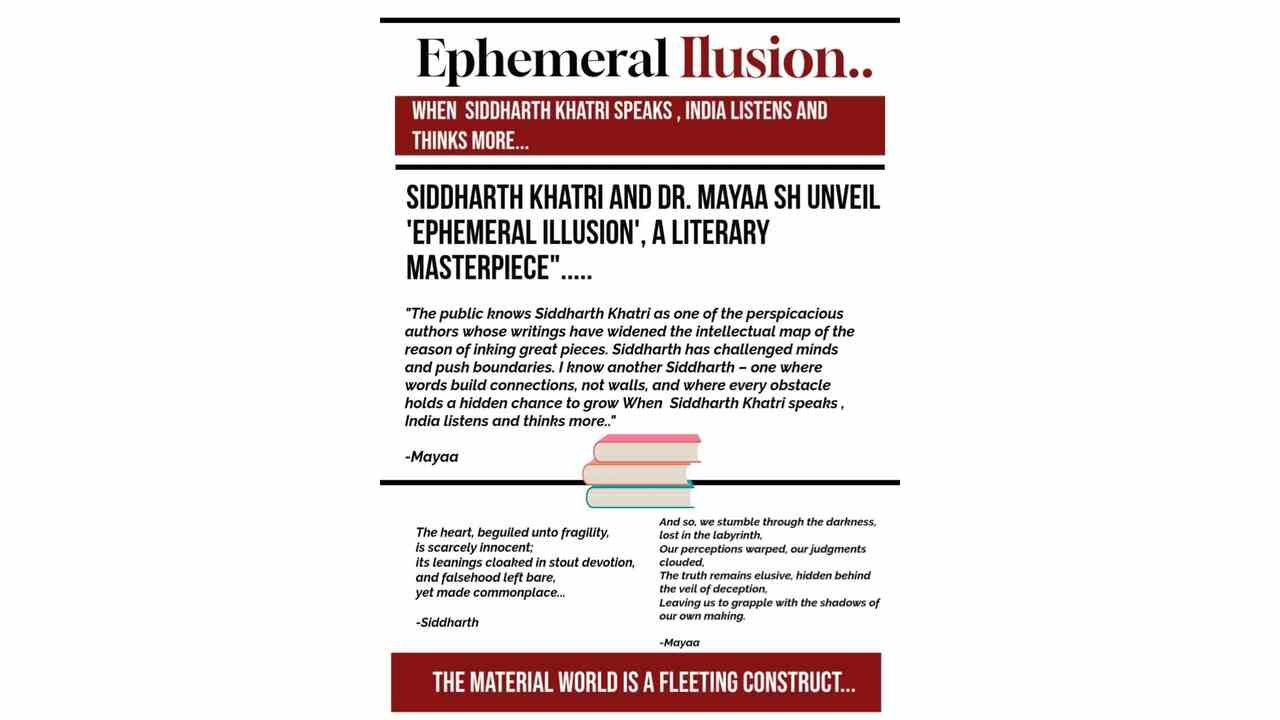
Dr Mayaa SH, a recognized literary figure in contemporary literature and an avid advocate for mental health and women’s empowerment, recently offered a profound tribute to her close friend ,a confidant and a great mentor, commonly referred as “Sir Siddharth Khatri” by her. The occasion was the publication of Khatri’s latest thoughts along with her on a literary masterstroke titled “Ephemeral Illusion,” which explores the transient nature of human existence and the pursuit of meaning in a world of shifting perceptions. Dr Mayaa SH expressed her admiration for a brilliant opportunity to come together through a symbolic standing ovation, praising Siddharth Khatri for his ability to articulate the “meaning of life” as a delicate balance between the physical reality we inhabit and the spiritual legacy we leave behind. According to her . “The public knows Siddharth Khatri as one of the perspicacious authors whose writings have widened the intellectual map of the reason of inking great pieces. Siddharth has challenged minds and pushed boundaries. I know another Siddharth – one who believes in building connections, not walls, and where every obstacle holds a hidden chance to grow When Siddharth Khatri speaks , India listens and thinks more..”
In her detailed commentary on the poem, Dr Mayaa SH analyzed the thematic depth of “Ephemeral Illusion,” noting that the title itself suggests that the material world is a fleeting construct. She emphasizes that Khatri’s verses serve as a mirror to the human soul, reflecting the struggle to find permanence in an impermanent universe. According to Dr Mayaa, the poem suggests that the true meaning of life is not found in the accumulation of wealth or status, but in the “authenticity of one’s emotions and the depth of one’s connections.” She highlighted that the “illusion” mentioned in the poem refers to the distractions of the ego, while the “ephemeral” nature of life serves as a reminder to live with intention and compassion.
The collaboration and mutual respect of these two literary figures have been noted across various literary platforms, where Dr Mayaa SH frequently contributes insights on contemporary literature and social change. By celebrating Khatri’s work, she reinforces the idea that poetry is a vital tool for philosophical inquiry, helping individuals navigate the complexities of the 21st century. Her endorsement of “Ephemeral Illusion” underscores a shared vision where art acts as a bridge between the mundane and the divine, urging readers to look beyond the surface of their daily lives to find a more profound, lasting truth.
Ephemeral Illusion…
There lieth somewhat amiss within this illusion,
Not proclaiming its coming with base vulgarity,
It stealeth in—quiet, near apologetic—
into the lacunae where conviction ought reside,
and there assumeth dominion unopposed.
No vulgar deceit attendeth it
rather,
it insinuateth itself as truth,
its falsehoods clad in the garb of certainty,
and swallowed whole by minds unpractised in doubt.
No intent attendeth it, nor any malice abideth,
it neither pursueth nor persuadeth,
but simply persisteth—quiet, inevitable—
left for others to discern,
or else to overlook.
The heart, beguiled unto fragility,
is scarcely innocent,
its leanings cloaked in stout devotion,
and falsehood left bare,
yet made commonplace.
In silent stealth, it creeps into our minds,
A phantom of deception, subtle and insidious,
It weaves a complex web of deceit, exploiting our vulnerabilities,
Its presence is felt, but its true nature remains hidden.
The heart, a willing host, receives the seeds of falsehood,
Nourishing them with emotions and desires,
The mind, distracted and unguarded, allows the illusion to take root,
And soon it spreads, insinuating itself into our thoughts and perceptions.
The boundaries between truth and falsehood begin to blur,
As the illusion takes hold, shaping our understanding of reality,
We cling to it, even as it distorts and manipulates,
A fragile construct, propped up by our own fears and desires.
And so, we stumble through the darkness, lost in the labyrinth,
Our perceptions warped, our judgments clouded,
The truth remains elusive, hidden behind the veil of deception,
Leaving us to grapple with the shadows of our own making.
-Siddharth Khatri & Dr Mayaa SH
The poem “Ephemeral Illusion” explores the theme of deception and self-deceit, highlighting how illusions can subtly infiltrate our minds and shape our perceptions of reality. The poem describes an illusion that creeps in quietly, without fanfare or aggression, and takes hold in the spaces where our convictions are weak. It masquerades as truth, cloaking its falsehoods in certainty, and is often accepted without question by minds unpracticed in doubt.
The illusion is depicted as a subtle and insidious force that exploits our vulnerabilities, weaving a complex web of deceit. It doesn’t pursue or persuade; it simply exists, persisting quietly and inevitably, left for us to discern or overlook. The heart, described as fragile and beguiled, is complicit in this process, often leaning towards the illusion due to its own desires and emotions.
As the illusion takes hold, it shapes our understanding of reality, blurring the boundaries between truth and falsehood. We cling to it, even as it distorts and manipulates, because it feeds on our fears and desires. The poem suggests that our perceptions become warped, and our judgments clouded, making it difficult to distinguish reality from illusion.
Ultimately, the poem leaves us with the idea that the truth remains elusive, hidden behind the veil of deception. We are left to grapple with the shadows of our own making, struggling to find our way through the labyrinth of illusions. The poem serves as a reflection on the human condition, highlighting our susceptibility to deception and the importance of discernment in navigating the complexities of truth and reality.
There lieth somewhat amiss within this illusion :
The poem begins by hinting that there’s something wrong or off about the illusion being described. It’s not immediately clear what the issue is, but the speaker suggests that it’s not quite right.
Not proclaiming its coming with base vulgarity :
The illusion doesn’t announce itself loudly or obnoxiously. It doesn’t force itself on us or try to draw attention to itself. Instead, it approaches quietly and subtly.
It stealeth in—quiet, near apologetic— into the lacunae where conviction ought reside, and there assumeth dominion unopposed :
The illusion sneaks in quietly, almost apologetically, into the gaps or weaknesses in our convictions. It fills the spaces where our beliefs or values are uncertain or lacking, and takes control without resistance. The phrase “near apologetic” suggests that the illusion is almost timid or unassuming, making it harder to detect.
No vulgar deceit attendeth it rather, it insinuateth itself as truth :
The illusion doesn’t involve blatant or obvious lies. Instead, it subtly suggests itself as the truth, making it harder to distinguish from reality. The word “insinuateth” implies a sneaky or sly approach.
Its falsehoods clad in the garb of certainty, and swallowed whole by minds unpractised in doubt :
The illusion presents its falsehoods as certainties, making them more convincing. People who aren’t used to questioning or doubting things tend to accept these falsehoods without critically evaluating them.
No intent attendeth it, nor any malice abideth; it neither pursueth nor persuadeth, but simply persisteth—quiet, inevitable— :
The illusion doesn’t have a specific intention or malicious motive. It simply exists and persists, quietly and inevitably, without actively pursuing or trying to convince people. It’s a passive force that just is.
Left for others to discern, or else to overlook :
It’s up to individuals to figure out the illusion for themselves or ignore it. The illusion doesn’t care either way.
The heart, beguiled unto fragility, is scarcely innocent; its leanings cloaked in stout devotion, and falsehood left bare, yet made commonplace :
The heart (or emotions) is vulnerable to the illusion, and often complicit in its own deception. The heart’s biases and desires are hidden behind a mask of strong emotions or convictions, making it hard to see the falsehood for what it is.
The next few lines describe the illusion’s effects:
In silent stealth, it creeps into our minds, A phantom of deception, subtle and insidious :
The illusion sneaks into our minds quietly, like a ghost or phantom. It’s a subtle and sneaky form of deception.
It weaves a complex web of deceit, exploiting our vulnerabilities :
The illusion creates a complicated network of lies that takes advantage of our weaknesses and vulnerabilities.
Its presence is felt, but its true nature remains hidden :
We might sense that something is off, but we can’t quite put our finger on what it is. The illusion’s true nature remains hidden.
The heart, a willing host, receives the seeds of falsehood, Nourishing them with emotions and desires :
The heart (or emotions) is receptive to the illusion and helps it grow by feeding it with emotions and desires.
The mind, distracted and unguarded, allows the illusion to take root, And soon it spreads, insinuating itself into our thoughts and perceptions :
The mind is distracted and unprepared, allowing the illusion to take hold. It then spreads and influences our thoughts and perceptions.
The boundaries between truth and falsehood begin to blur, As the illusion takes hold, shaping our understanding of reality :
As the illusion grows stronger, it becomes harder to distinguish truth from lies. The illusion starts to shape our view of reality.
We cling to it, even as it distorts and manipulates, A fragile construct, propped up by our own fears and desires:
We hold onto the illusion, even though it’s fragile and based on our own fears and desires, which are distorting reality.
And so, we stumble through the darkness, lost in the labyrinth, Our perceptions warped, our judgments clouded :
As a result, we’re lost and confused, unable to see things clearly. Our perceptions are distorted, and our ability to judge things is impaired.
The truth remains elusive, hidden behind the veil of deception, Leaving us to grapple with the shadows of our own making :
The truth is hard to find, hidden behind the illusion’s deception. We’re left to deal with the consequences of our own mistakes and misconceptions.
The logical progression of Dr Mayaa’s inspiration stems from her own philosophical alignment with the poem’s themes. Dr. Mayaa SH often emphasizes the importance of “inner engineering” and mental well-being; thus, Khatri’s depiction of life as an “ephemeral” journey resonated with her mission to encourage people to seek substance over superficiality.She specifically highlighted the poem’s ability to act as a mirror for the soul, urging readers to dismantle the facades they build around their identities. By analyzing the linguistic depth and the melancholic yet hopeful tone of the verses, she aimed to bridge the gap between contemporary poetry and the timeless quest for self-actualization.
Furthermore, her analysis has been driven by a desire to emphasise on literary voices that challenge the status quo of “fast-paced” digital consumption. She has viewed “Ephemeral Illusion” not just as a piece of literature, but as a meditative tool that aligns with her advocacy for mindfulness and the rejection of toxic societal expectations.
In the critical discourse surrounding “Ephemeral Illusion,” Dr. Mayaa SH emphasizes the theme of existential impermanence, suggesting that Khatri’s work serves as a meditative reflection on the t → ∞ limit of human legacy, where individual achievements often fade into the “void” of time. The poem explores the duality between the internal soul and the external facade.Besides ,
this highlights the struggle for authentic identity in a hyper-digital age, where the “illusion” is compounded by social media and virtual personas, leading to a sense of fragmented selfhood.
The logical progression of the poem’s themes, as analyzed by Dr. Mayaa SH, moves from the recognition of life’s fragility to the ultimate liberation found in accepting change. This aligns with broader millennial trends in literature that seek to “rewrite hope and healing” amidst global and personal crises. By stripping away the layers of “ephemeral” attachments, Siddharth Khatri’s verses encourage a return to core human values and emotional honesty, providing a counter-narrative to the “urban anxiety” and “technological modernity” that dominate much of 21st-century discourse.
Dr. Mayaa SH, a prominent literary critic and advocate for emotional intelligence in literature, posits that Khatri utilizes “sensory-fluid imagery” to bridge the gap between the physical world and the subconscious, where the recurring motif of “The heart, beguiled unto fragility,is scarcely innocent”; serves as an emphasis for the cursory nature of human heart and the fleeting nature of modern relationships.
© 2026 by Siddharth Khatri and Mayaa SH. All rights reserved. No part of this publication may be reproduced, distributed, or transmitted in any form or by any means, including photocopying, recording, or other electronic or mechanical methods, without the prior written permission of the media house and the authors , except in the case of brief quotations embodied in critical reviews and certain other noncommercial uses permitted by copyright law.”
