


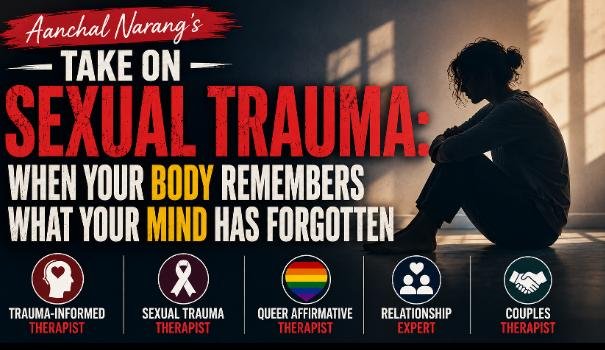
You are with someone you trust. You are comfortable. You may even be looking forward to being intimate. Then, somewhere in the middle of it, something changes. Your body becomes tense. You stop responding. You suddenly want the lights off. You feel the need to get away. Or you remain physically present, but emotionally, you are no longer there.
And afterwards, you may find yourself asking a question that is difficult to say out loud: “Why did that happen when I was completely safe?”
According to therapist Aanchal Narang, there is a question worth exploring without immediately blaming yourself, your relationship, or your desire: Does your sexual life trigger your past trauma?
When your body remembers what your mind has moved past
Trauma does not always return as a clear memory. Sometimes, it appears as a bodily response.
A particular touch, position, tone of voice, loss of control, smell, or even the vulnerability of being physically close can activate a nervous system that has learned to stay alert.
Wanting intimacy but not wanting to be touched
One of the less-discussed effects of past trauma is the contradiction between desire and physical comfort.
A person may genuinely want intimacy, feel attracted to their partner and even initiate sex, but become uncomfortable once physical closeness begins. This does not automatically mean they have lost attraction or that something is wrong with their relationship.
Research has found significant associations between PTSD and difficulties with sexual function, desire, satisfaction and sexual distress.
Sometimes, the more useful question is not “Why don’t I want this?” but “What happens inside me when intimacy begins?”
When freezing is mistaken for consent
Not every trauma response looks like panic or resistance. Some people freeze.
They become quiet, stop participating, disconnect from their bodies or simply wait for the experience to end. Later, they may feel confused because they never explicitly said “no.”
This is an important part of conversations around trauma and sexual intimacy: consent is not simply the absence of refusal. People need to feel able to pause, change their minds and communicate their boundaries throughout an intimate experience.
For someone with a history of trauma, learning that they are allowed to stop can be an important part of rebuilding safety.
When control becomes a way of feeling safe
Another response that is rarely discussed is the need for control.
Someone may need intimacy to happen in very specific ways: particular lighting, timing, positions, routines or boundaries. From the outside, this may look like being overly particular.
But sometimes, control is the nervous system’s way of creating predictability.
If unpredictability was once connected with danger, knowing what happens next can feel reassuring. Trauma-informed therapy does not necessarily try to take that control away. Instead, it explores whether those preferences are freely chosen or driven by fear.
The numbers behind trauma
The connection between trauma and mental health is not merely anecdotal.
A 2023 systematic review examining adult survivors of sexual assault found that its effects can extend beyond psychological distress, affecting sexual, physical, psychological and social functioning.
The review reported concerns including sexual difficulties, pain, reduced self-esteem and lower quality of life showing how sexual trauma can sometimes continue to shape intimacy, wellbeing and a person’s relationship with their own body long after the experience itself.
It does not have to be sexual trauma
Past trauma affecting your sexual life does not necessarily mean experiencing sexual assault.
Emotional abuse, childhood neglect, body shaming, coercive relationships, medical trauma, bullying or being repeatedly taught that sexuality is shameful can all influence how someone experiences vulnerability and intimacy.
Sometimes the wound is not one dramatic incident. Sometimes it is years of learning that your body is not entirely yours or it’s not okay the way it is.
Aanchal Narang’s take: Start with curiosity, not shame
As a therapist working with trauma, sexuality and relationship concerns, Aanchal emphasises the importance of looking beyond the visible symptom.
Instead of asking, “What’s wrong with me?”, it can be more helpful to ask:
“What is my body trying to protect me from?”
That shift from judgement to curiosity can make space for genuine healing.
Most frequently asked Questions from Aanchal Narang about sexual harassment and trauma:
Can past trauma affect your sex life years later?
Yes. Trauma-related responses can continue long after an experience, although everyone responds differently.
Can you love your partner and still be triggered during sex?
Yes. Love, attraction and nervous-system safety are not always experienced simultaneously.
Can trauma-informed therapy help with sexual difficulties?
It can help people understand triggers, develop safety and reconnect with their bodies and boundaries without shame.
Start Your Therapy with Aanchal
- Another Light Counselling Website: https://www.another-light.com
- Book a Therapy Session via WhatsApp: https://wa.me/918879260310
